A visitor steps into a hospital corridor. Nothing about that moment feels unusual. A few doors later, the same person could be close enough to the MRI system for a forgotten metal object—or an incorrectly cleared device—to become a serious problem. The distance matters, but access control matters more.
The American College of Radiology (ACR) organizes MRI facilities into four safety zones. They help teams distinguish public space from screening, restricted access, and the magnet room itself. This guide explains the boundaries, common misconceptions, and why the 2026 ACR update matters. [1, 2]
What changes from Zone I to Zone IV?
Corridors and spaces open to patients and visitors before entering the controlled MR pathway.
Normal public accessReception, changing and preparation areas where screening and patient readiness are addressed.
Preparation & screeningRestricted areas supervised under the facility's MR safety program. This may include the control room and relevant magnetic-field hazard areas beyond the scanner room.
Authorized, controlled entryThe magnet is here. Entry requires the screening, supervision and final checks specified by the site's MR safety procedures.
Highest access restrictionsA zone describes a safety function, not a universal floor plan. Hospitals may arrange rooms differently; field boundaries and access controls must be assessed for each site.
Zones I and II: where the conversation starts
Zone I is ordinary public-access territory. A person can be there without having completed MR screening.
Zone II is the transition into the MRI process. This is where patients may change clothes and answer questions about implants, prior surgery, metallic foreign bodies, personal items and accompanying equipment. But a form isn't a substitute for resolving an unclear device or obtaining the required clearance.
For example, someone saying they have “a metal implant” does not establish whether it is MR Safe, MR Conditional, or MR Unsafe. Product identification, device-specific conditions and local policy come first. [1, 3]
Zone III: the doorway is not the whole boundary
Zone III is an MR Controlled Access Area. Unscreened non-MR personnel and unchecked ferromagnetic objects do not get free access. The supervising Level 2 MR personnel control entry and activities under the ACR approach. [2]
Often this area includes the operator console and the entry to Zone IV. But the magnetic field can extend beyond a typical room boundary. The March 2026 ACR revision explicitly addresses locations where the MR environment extends outside the scanner room, including noncontiguous areas at risk from magnetic fields. [2]
“I only need to step into the control area for a second.” Brief access is still access. Professional role or familiarity with the department doesn't replace the required screening and supervision.
Zone IV: the scanner doesn't switch off between patients
Zone IV contains the MRI scanner. With a conventional superconducting magnet, the static magnetic field normally remains present between sequences and after the console has stopped scanning. A paused examination is not a safe-entry signal for unchecked objects.
In addition to personal belongings, think about transfer equipment, monitoring devices, accessories and leads. MR Conditional labeling must be checked against the exact conditions of use; it is not a blanket permission to bring an item into every scanner. [1, 3]
The ACR's 2026 changes also emphasize functional checks of Zone IV equipment and draw attention to risks from unused conductive cables and disconnected surface coils. These points belong in approved local procedures—not an improvised checklist at the doorway. [2]
Why even a personal item matters
In January 2026, an FDA device-event report described a metal pill holder concealed in a patient's clothing being drawn toward the scanner and striking the head coil. The narrative reported no patient harm. It is one documented case, not evidence of how frequently this happens. Read the original-record breakdown →
A different, fatal incident in New York in July 2025 involved a visitor wearing a large metallic chain. Our incident file separates the police account from disputed witness details. Both events illustrate why zone boundaries have to work when people are distracted, rushed or unfamiliar with MRI. [4]
Can you explain these without guessing?
Can a hospital employee walk straight into Zone III because they work there?
No blanket permission follows from an employee badge. Access, screening and supervision depend on MR personnel status and approved facility procedures.
Does MR Conditional mean compatible with any 1.5T or 3T scanner?
No. Conditions can specify field strength, spatial gradient, SAR or B1+rms, coil configuration, device placement and other limits. Verify the specific product instructions.
If image acquisition stops, is the projectile risk gone?
No. The static magnetic field of a typical superconducting MRI system remains present even when the scanner is not acquiring images.
Safety makes more sense when the details connect.
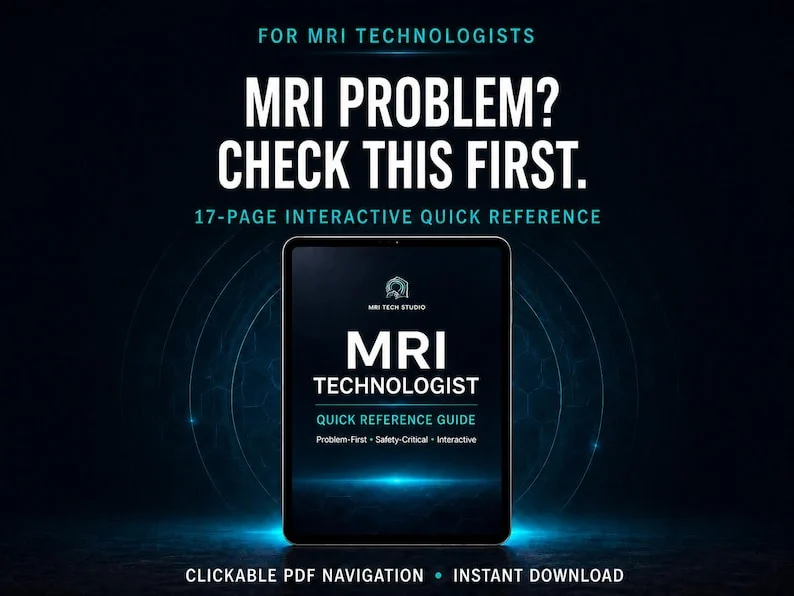
Want a compact reference for screening, safety, artifacts and MRI workflow? Explore our 17-page interactive MRI Technologist Quick Reference before viewing current details and price on Etsy.
Explore the guideIndependent learning material. Not a site-approved screening tool or patient-specific clearance procedure.
Check the source, not just the summary.
- ACR — MR Safety resources and the 2026 manual ↗
- ACR — March 2026 changes to the MR Safety Manual (PDF) ↗
- FDA — MRI benefits, risks and device conditions ↗
- NPR — July 2025 MRI chain incident, citing police ↗
Educational overview, not medical advice or an approved safety procedure. Follow current ACR guidance, manufacturer labeling and institutional MR policies.